The fun news for brands: consumers started their fall shopping early this year.
About one third of back-to-school shoppers had already begun browsing and buying by early June, the highest share since the National Retail Federation started tracking the question in 2018, and 44% had received their school lists by early June compared with 38% a year ago. For brands in food and beverage, health and wellness, beauty, and construction materials, back-to-school works as a read on consumer behavior. It says the buying curve turned upward well before August, and the volume you fulfill in Q4 is already building.
We are anticipating that Q4 volume grows as well. eMarketer projects roughly 6.6% ecommerce growth for the 2026 holiday season, in line with 2025 and stacked on a record base. Last peak moved about 2.3 billion parcels, up 5% year over year, while consumers spent $257.8 billion online between November 1 and December 31, an all-time high.
It is highly likely that a brand’s order count in November of 2026 will be more than their current fulfillment network was designed to deliver.
The Risks of Waiting Until October
Brands that take a look at their fulfillment network earlier and optimize where they store their inventory have a leg up. By making a shift in August, a brand has September to stabilize and October to fine tune.
By October, fulfillment centers have committed their peak labor and dock time across every client they serve. Overflow capacity in the markets you would find most advantageous (the ones sitting closest to your customers) is not guaranteed to be available. If your brand sells goods that need special storage considerations, such as food safe or chemical safe, the options get slimmer, sooner.
Why does where you ship from matter so much? Zone cost is the piece brands set aside most often, and it rewards attention. Carriers price by distance, so an order traveling from a single warehouse to a customer three time zones away costs more than the same order shipped from a building nearby.
Brands with inventory close to their customers pay less for the same delivery promise. Multiply that gap across a peak order count, and you can see how optimizing your zones would impact your margins significantly. Those savings land harder this year, because affordability is top of mind for shoppers and about half of families told NRF they shopped earlier out of concern that prices would rise. A brand that ships from closer in passes along lower costs and faster delivery, and that better value is what turns a first-time buyer into a repeat one.
How a Distributed Fulfillment Network Changes Your Peak Margins
When inventory sits closer to your customers, the same order travels a shorter distance, lands in a nearer zone, and moves on a faster ground service. Kinimatic operates a network of 350+ fulfillment locations nationwide, which puts stock within ground range of most of your customers and gives you room to spread peak volume across multiple buildings.
Brands add capacity where they need it and are able to keep the partner relationships that are working intact. A brand with a strong West Coast 3PL can add East Coast and Midwest coverage for peak and absorb overflow through the network while the existing operation stays in place, all without long-term commitments or disruption to current operations. That range is the point. A brand can stand up a full network or, at the other end, keep just a couple of locations in reserve as insurance for the surge, adding single nodes through our Network Optimization System wherever the map shows the biggest gap.
“The brands that come through peak in good shape gave themselves options before the volume arrived. Optimizing your network in August or September is a strategic decision. Scrambling to add capacity in November is an emergency.” Kris Kellaway, Co-Founder and President, Kinimatic
Peak Season Onboarding: What Live in Weeks Looks Like
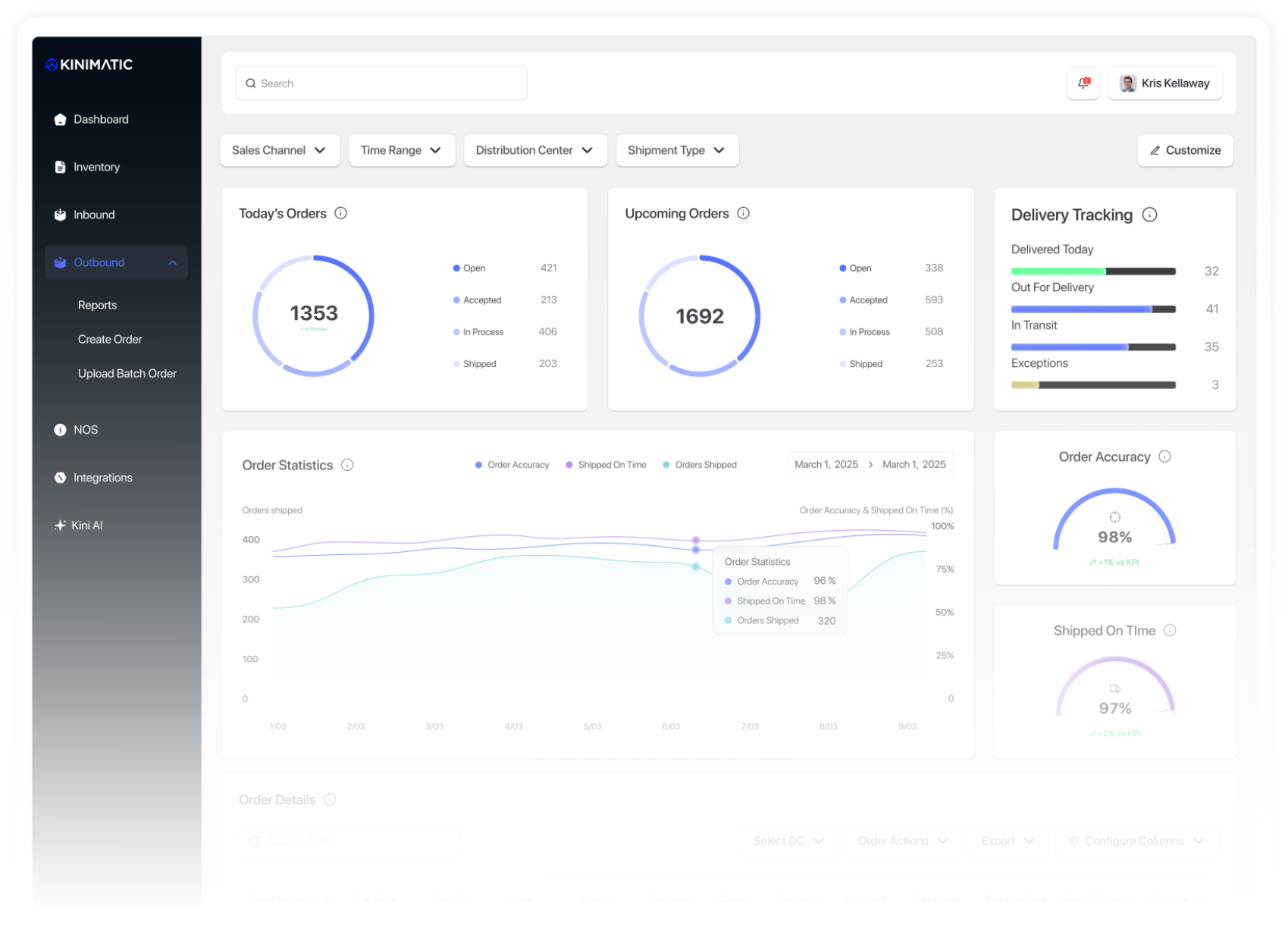
Getting your brand ready for the increased volumes of peak season starts with a network analysis. At Kinimatic, we will review your order data and customer geography to find the locations that give you the most delivery coverage for the least movement of inventory. Our Network Optimization System will provide you with a visual breakdown of how many DCs you should consider using in peak and where they should be set up, so you can determine what is most important to your brand.
Once you review your options, getting set up is made simple and designed to not cause your ops to skip a beat. Kinimatic connects to your existing stack through 400+ prebuilt integrations spanning ERPs, shopping carts, retailers, and commerce platforms, so your ecommerce platform and your internal tools stay where they are.
Inventory ships to the selected locations, gets received and counted, and orders begin routing. Your team sees the same order flow it sees today, with each order fulfilling from the building closest to the customer. Pace of onboarding varies with SKU count and how quickly your inventory can move.
Evaluate Whether Your Network Is Ready for Peak
If your team is not sure whether your network is optimized for speed and cost, we would love to help you review your options. The value of the Kinimatic model is the speed to add new, more optimal locations and the flexibility of short-term and seasonal availability.